Article: What's My Skin Dosha? And Why Your Online Quiz Keeps Getting It Wrong
What's My Skin Dosha? And Why Your Online Quiz Keeps Getting It Wrong
To find your skin dosha, watch your skin's long-term tendencies instead of trusting a single quiz. Lasting dryness and fine texture point toward Vata, warmth and easy redness toward Pitta, richness and extra oil toward Kapha. Most people are a blend of two. The pattern that holds across seasons, not the one week you took the test, is your truest answer.
Chances are you have already tried the quiz route. You answered the questions honestly. Twelve of them, maybe fifteen, about whether your skin runs dry or oily, whether you feel the cold, how you handle stress. At the end a single word appeared, confident and clean: Vata, or Pitta, or Kapha. It felt like an answer. Then a week later you took a different quiz, gave the same honest answers, and it told you something else entirely. So you are left where many thoughtful people land, holding two verdicts and trusting neither, wondering which dosha your skin actually is.
The frustrating part is that the dosha framework is genuinely useful; the quizzes are the problem. A five-question test compresses something layered into a single label, and that compression is where the contradictions come from. Here is what a skin dosha really describes, why the quizzes keep disagreeing, and how to read yours in a way that guides how you care for your skin.
Why Do Two Quizzes Give You Two Different Answers?
The contradiction is almost built in. Most quizzes blend two very different kinds of questions, some about your lifelong nature and some about how your skin has behaved lately, then average everything into one tidy result. Adjust a few answers after a stressful month or a humid week, and the label flips. You were not being inconsistent. The tool was measuring two things at once and reporting them as one.
Two dosha quizzes give two different answers because most quizzes mix questions about your lifelong nature with questions about how your skin has behaved lately, then average everything into one label. Shift a season or a stressful month and the result flips, even though your answers were honest.
That is worth holding onto before you decide dosha thinking does not work for you. It works. It was simply handed to you in a format too small to carry it.
What Does a Skin Dosha Actually Describe?
In Ayurveda, the three doshas (the functional energies believed to govern the body and its tendencies, Vata, Pitta, and Kapha) are a way of describing patterns rather than fixed categories. Each carries a set of qualities, and most people are a blend with one or two more prominent. Applied to skin, the doshas become a vocabulary for tendencies you can actually observe.
Vata, Pitta, Kapha Skin at a Glance
A Vata-leaning pattern tends toward dryness, fineness, and quick change, skin that can look dull or feel tight when depleted. A Pitta-leaning pattern runs warm and sensitive, more prone to visible redness and reactivity. A Kapha-leaning pattern is rich and resilient, often with more oil and a thicker, more cushioned quality. These are tendencies, not sentences. They describe how skin behaves, and they offer a lens for choosing care rather than a destiny to resign yourself to.
A skin dosha describes observable tendencies, not a fixed category. In Ayurveda, Vata-leaning skin tends toward dryness and quick change, Pitta-leaning skin toward warmth and visible redness, and Kapha-leaning skin toward richness and extra oil. Most people are a blend, with one or two patterns more prominent.
Where Do Dosha Quizzes Go Wrong?
The deeper issue is that Ayurveda has always made a distinction the quizzes quietly erase. There is your underlying constitution, the nature you were born with, and there is your current state, the way your skin behaves right now under the influence of season, stress, diet, and the products you use. These two often diverge. A quiz that mixes them and hands back one word cannot tell you which it measured. You might receive a label describing your lifelong nature while staring at skin shaped entirely by this month.
Dosha quizzes go wrong when they erase Ayurveda's oldest distinction: prakriti, the constitution you were born with, and vikriti, the current state your skin is in under season, stress, and products. A quiz that blends the two into one word cannot tell you which one it measured.
This is the heart of the confusion, and it has its own names and its own logic, which is worth understanding properly. We unpack the full distinction in our piece on prakriti versus vikriti, the constitution-versus-current-state idea that resolves nearly every dosha contradiction.
How Do You Read Your Skin Dosha More Honestly?
The better approach asks a little more of you and rewards you with an answer you can trust. Observe your skin over time rather than in a single snapshot, and notice the difference between what it does as a baseline across years and what it is doing this particular season. Hold the two separately. The baseline points toward your constitution; the recent behavior is your current state. Read them as two layers instead of one label, and the picture stops contradicting itself and starts being useful.
To read your skin dosha honestly, hold two layers apart: the baseline your skin has shown across years, which points to your constitution, and the way it behaves this season, which is your current state. Read them separately and the contradictions between quiz results largely resolve themselves.
A dosha read done this way is not a horoscope. It is a working hypothesis about how your skin tends to behave, refined by your own observation, and that is exactly the kind of input good care is built on.
How Does an Honest Dosha Read Change Your Ritual?
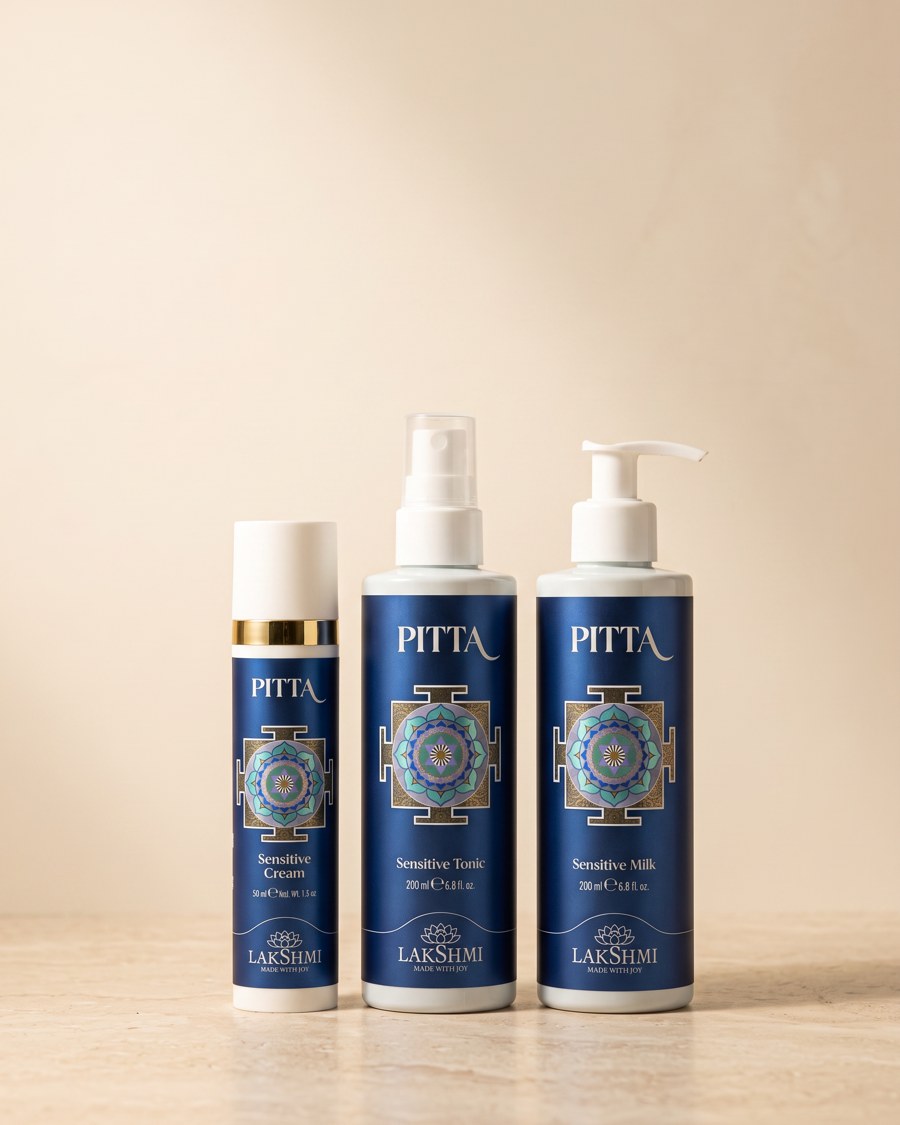
An honest dosha read only matters if it changes what you do at the sink. This is why Lakshmi treats the VPK Diagnostic Quiz as a considered starting point rather than a final verdict, and why its dosha rituals are designed to honor your constitution while responding to what your skin actually needs right now. A Vata-leaning ritual nourishes skin prone to dryness. A Pitta-leaning ritual cools and calms reactive skin. A Kapha-leaning ritual clarifies richer skin. And all of them are meant to flex as your skin shifts through the seasons.
Lakshmi treats the VPK Diagnostic Quiz as a considered starting point rather than a final verdict. Its dosha rituals are designed to honor your constitution while responding to what your skin needs now: a Vata ritual nourishes dryness-prone skin, a Pitta ritual calms reactive skin, and a Kapha ritual clarifies richer skin.
So if the quizzes have left you with more questions than answers, that is not a failure of the tradition or of your own self-knowledge. It is an invitation to read your skin with both layers in view. When you are ready, you can discover your dosha ritual and let the lens finally do what it was meant to do, which is guide you toward care that fits.
When you are ready, explore the VATA Comfort Ritual.
Related reading: Prakriti vs. Vikriti: why your skin defies your dosha · Understanding Pitta Skin and breakouts · the full dosha ritual guide
About the author
Franco Canteri is the co-founder of Lakshmi and the author of Lakshmi Ayurveda. In 1988 he and Linda Canteri traveled to India for one of the first Ayurveda courses of their generation, and in 1989 they founded Lakshmi on the hills of Verona. A yoga and meditation instructor, Franco has guided the brand's Ayurvedic-inspired formulation practice for more than thirty-five years. This article reflects that founding philosophy.
This article is for educational purposes and does not constitute medical advice. For persistent skin concerns, consult a dermatologist.