
Is Breakout-Prone Skin Really a Sign of "Too Much Heat"? Understanding the Pitta Connection
Breakout-prone skin is not simply a sign of too much heat. In Ayurveda, pitta (the principle of heat and inflammation) captures one real piece of the picture, yet breakouts have many drivers: diet, hormones, stress, a worn skin barrier, and the products you use all play a part. If you have spent any time in the Ayurvedic corner of skincare, you have absorbed a tidy explanation for breakouts: it is pitta, too much heat in the system. The idea satisfies because it gives a name to something that otherwise feels random. But you may also have run into its limits. Your skin breaks out during a calm, clean-eating stretch when there is no obvious heat to blame, and the explanation suddenly feels too small. If it is all pitta, why is this happening now?
The honest answer is that the heat theory holds a real kernel of truth and also leaves a lot out. Breakout-prone skin rarely comes from a single cause, and the most useful thing you can do is understand both what the pitta lens gets right and what it misses. Once you see the fuller picture, the routine that actually helps becomes obvious, and so does the moment to involve a professional.
Why Do We Blame Every Breakout on Pitta?
The instinct to trace every breakout to pitta is understandable, because heat and inflammation genuinely are part of breakout-prone skin. The trouble begins when one lens has to explain everything, since diet, hormones, stress, the skin barrier, and the products you use all shape skin at once.
The instinct to attribute every breakout to heat is understandable, because heat and inflammation genuinely are part of the story. The trouble starts when a single lens has to explain everything. Diet, hormones, stress, the barrier, and the products you use all shape skin, often at once. When breakouts appear during a period with no obvious dietary trigger, the pitta idea is not wrong; it was only ever describing one thread in a larger weave.
What Does the Pitta Heat Theory Get Right?
The pitta lens gets one thing right: inflammation sits at the center of breakout-prone skin, and stress can leave skin more reactive. When the tradition says heat and agitation show up on the face, it points at something dermatology recognizes, and the instinct to cool and calm is well founded.
There is real wisdom in the pitta framing. Pitta (the Ayurvedic principle of fire, heat, and transformation) maps onto something dermatology recognizes plainly: inflammation is central to breakout-prone skin. And the stress connection holds up too. Research links the stress hormone cortisol to changes in the skin, and elevated stress is associated with more reactive, breakout-prone skin in many people. So when the tradition says heat and agitation show up on the face, it is pointing at something measurable. The instinct to cool and calm is well founded.
What Does the Heat Theory Miss About Breakouts?
The heat theory misses the modern drivers of breakouts. Diets high in rapidly absorbed sugars, refined carbohydrates, and skim milk are associated with breakout-prone skin, and so are hormonal shifts, a worn skin barrier, and heavy or poorly suited products. Breakouts have many causes, not one.
Where the heat theory falls short is in everything else that drives breakouts, and one driver in particular has strong evidence behind it. Diets high in rapidly absorbed sugars and refined carbohydrates, along with skim milk specifically, raise levels of insulin-like growth factor 1 (IGF-1), a signaling molecule that stimulates the skin's oil glands and influences the inflammatory environment associated with breakouts. A large body of research, some of it involving tens of thousands of participants, supports this association, and the American Academy of Dermatology now acknowledges the emerging evidence. We cover the mechanism in depth in our piece on diet and skin.
Beyond diet, a disrupted skin barrier, hormonal shifts, and heavy or poorly suited products all contribute. The point is not to replace one single cause with another. It is to retire the idea of a single cause altogether.
Why "I Rarely Eat Those Foods" Can Still Mean Breakouts
This is exactly why the clean-eating stretch can still bring breakouts. If diet is only one of several drivers, removing it does not switch the others off. A stressful month, a hormonal shift, a barrier worn down by over-exfoliation, or a too-rich product can each carry the breakout on its own. Doing everything right and still breaking out usually means the cause is somewhere other than the one you were watching.
What Does a Cooling, Barrier-Respecting Ritual Look Like?
For skin that runs warm and reactive, gentleness works better than aggression. A mild cleanser and a calming, barrier-supportive step help soothe the look of redness and support the appearance of clearer, more even skin. With reactive skin, restraint tends to serve better than force.
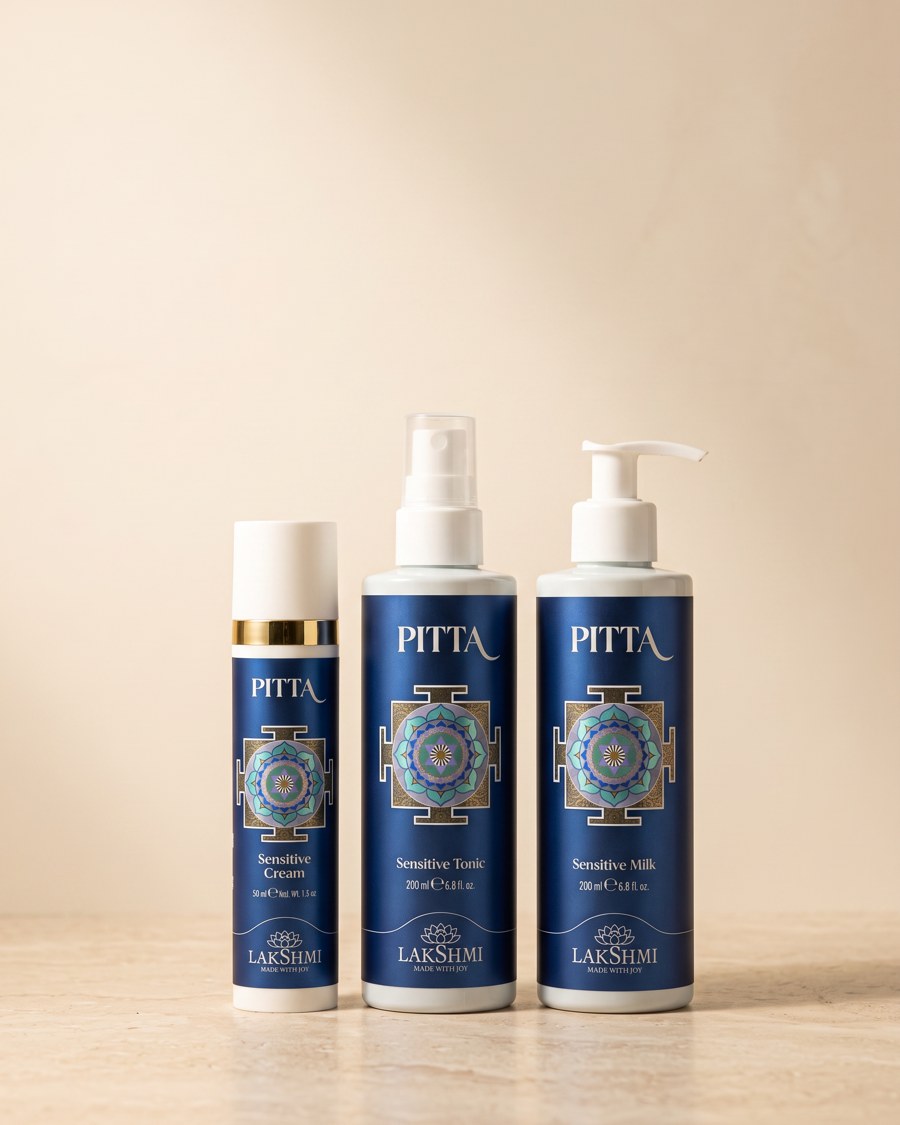
For skin that runs warm and reactive, the most effective routine is also the gentlest, because aggression tends to make breakout-prone skin worse rather than better. Cleanse without stripping, using a mild, low-friction cleanser such as Lakshmi's Pitta Sensitive Milk. Refresh with the Pitta Sensitive Tonic to calm and comfort, then seal in a barrier-supportive moisturizer such as the Pitta Sensitive Cream, formulated for reactive, redness-prone skin to support comfort rather than challenge an already agitated barrier. The three steps together make up the Pitta Balance Ritual. Once or twice a week, a clarifying treatment such as the Black Mud Mask can support the appearance of clearer skin without the harshness of an aggressive scrub. And as with all reactive skin, a gentle daily routine remains one of the most useful things for how your skin looks and feels.
The guiding principle is restraint. Calm the skin, protect the barrier, and resist the urge to attack a breakout into submission.
When Do Breakouts Need More Than a Ritual?
A gentle ritual supports the appearance and comfort of breakout-prone skin, but it does not treat acne. If your breakouts are persistent, painful, cystic, or leaving marks, that is a medical matter for a dermatologist. Seeing one is using the right resource, not a failure of your ritual.
A ritual supports the appearance and comfort of breakout-prone skin. It does not treat acne, and that line is worth stating plainly. If your breakouts are persistent, painful, cystic, or leaving marks, that is a medical matter and deserves a dermatologist's care. Acne is treatable, and a clinician has tools that no cosmetic can replicate. Seeing one is not a failure of your ritual. It is using the right resource for the job, the same way you would for anything else that affects your health.
So let the pitta lens be what it is, a real and useful way to notice heat and agitation in your skin, held alongside the fuller understanding that breakouts have many drivers. Care for your skin gently, watch for the patterns the heat theory alone would miss, and keep a dermatologist in your corner for anything that persists. When you are ready, you can discover the cooling ritual for breakout-prone skin.
Related reading: Does diet really show up on your skin? · Pitta flush or rosacea? · Prakriti vs. Vikriti
About the author
Franco Canteri is the co-founder of Lakshmi and the author of Lakshmi Ayurveda. In 1988 he and Linda Canteri traveled to India for one of the first Ayurveda courses of their generation, and in 1989 they founded Lakshmi on the hills of Verona. A yoga and meditation instructor, Franco has guided the brand's Ayurvedic-inspired formulation practice for more than thirty-five years. This article reflects that founding philosophy.
This article is for educational purposes and does not constitute medical advice. Acne is a medical condition; consult a dermatologist for persistent or painful breakouts.
%20captures%20one%20real%20piece%20of%20the%20picture,%20yet%20breakouts%20have%20many%20drivers:%20diet,...)