
Can You Layer Ayurvedic Oils With Retinoids and Acids? The Hybrid Routine, Done Safely
Yes, you can layer an Ayurvedic-inspired facial oil with tretinoin, retinoids, or exfoliating acids. The key is sequence and restraint: put water-based actives on clean skin first, let a nourishing oil come last, avoid piling everything into one night, and ask your dermatologist before adding an oil to any prescription routine. Do that, and the two worlds coexist comfortably.
Your bathroom shelf tells the story of a modern skincare life. A prescription retinoid you have worked hard to tolerate. An exfoliating acid two nights a week. A vitamin C in the morning. And now, drawn by the idea of something more nourishing and rooted, you are eyeing an Ayurvedic facial oil and wondering whether it can join the lineup or whether it will undo months of careful progress. It is a genuinely good question, and one almost nobody answers well, because the two worlds rarely speak to each other.
The reassuring news is that modern actives and traditional botanical oils can coexist in one routine. They are not enemies. What they need is sensible sequencing and a little restraint, plus one clear boundary around anything your dermatologist prescribed. Here is how the hybrid routine actually works.
Is There Really No Rulebook For Mixing Modern Actives With Ancient Oils?
This feels confusing because the guidance rarely exists. Clinical skincare talks about actives. Ayurvedic skincare talks about oils and rituals. Very little sits in the middle, where a real person is trying to use both at once. So people either avoid the oil entirely out of caution or throw it on top of everything and hope. Neither is necessary once you understand how oils and actives relate on the skin.
Layering modern actives with an Ayurvedic-inspired oil rarely comes with instructions, because clinical and traditional skincare seldom speak to each other. You do not have to avoid the oil or pile it on blindly. Once you understand how oils and actives relate on skin, a sensible middle path opens up.
How Do Actives And Botanical Oils Actually Interact On Skin?
Start with the cast. A retinoid (a vitamin A derivative that supports the appearance of renewal and is among the best-evidenced ingredients for the look of aging and uneven tone) and AHA or BHA acids (chemical exfoliants that loosen and lift dead surface cells) are your actives, the ingredients doing targeted work. A botanical facial oil is largely an emollient and occlusive, something that nourishes and seals rather than chemically transforming the skin.
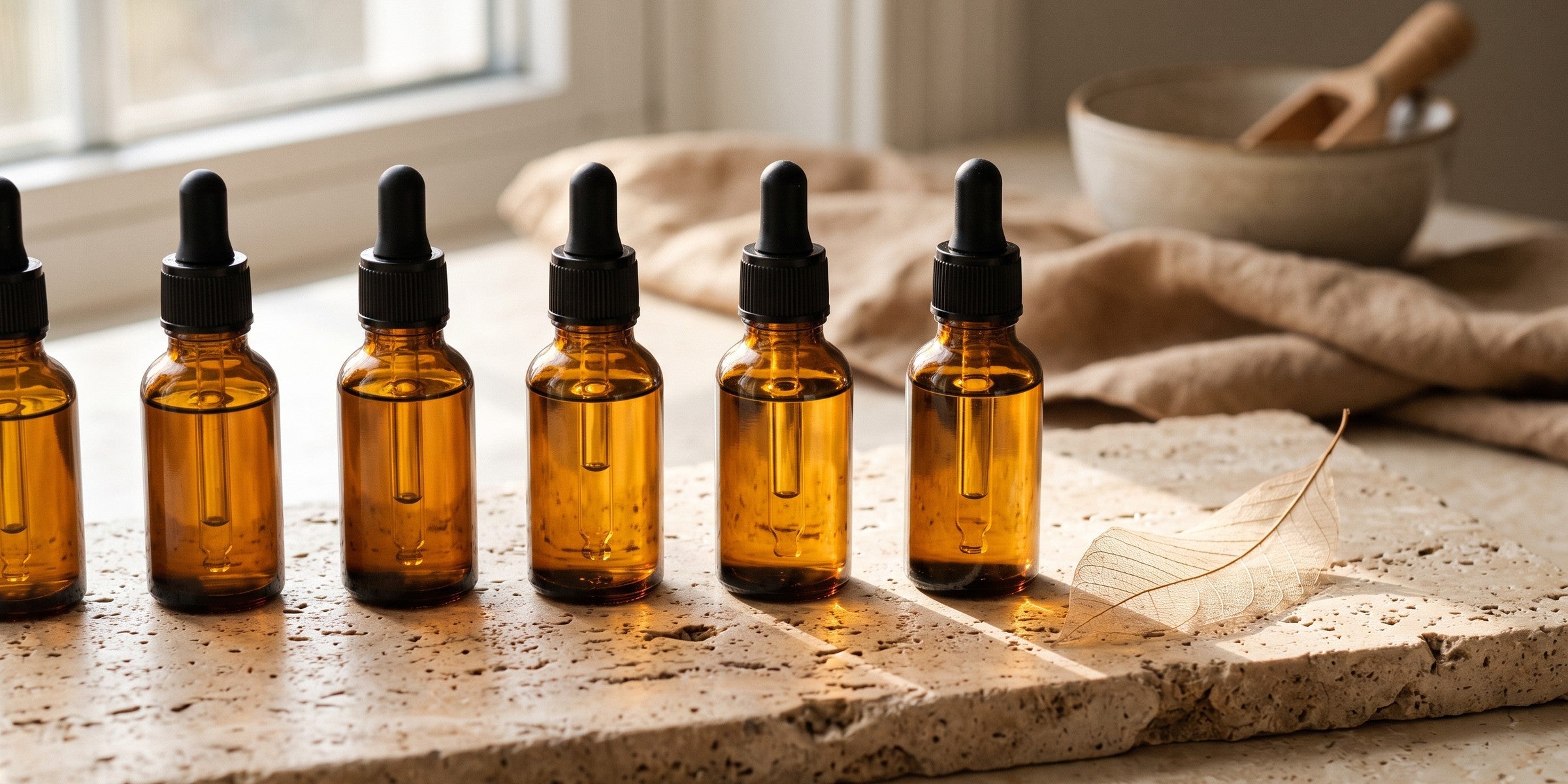
A botanical facial oil behaves mostly as an emollient and occlusive, not a competing active, so it does not generally cancel out a retinoid or an acid. What an oil mainly changes is tolerance and absorption, which is why the order you apply things still matters.
Because an oil is not a competing active, it does not generally cancel out a retinoid or an acid. What it does affect is tolerance and absorption, which is why order and timing matter even when there is no chemical conflict. Get the sequence right and the oil supports the very barrier that strong actives can wear down.
Barrier-First Sequencing
A few principles cover most situations. As a general rule, apply water-based and active treatments first, onto clean skin, and let an oil come last, since oils seal in what is beneath them but are harder for water-based actives to penetrate in reverse. For strong actives, consider alternating nights rather than piling everything into one routine. If your skin is sensitive, buffering (applying a moisturizer or oil shortly before or after a retinoid) can improve tolerance. And lean on a nourishing oil on the nights your barrier feels compromised, because supporting the barrier is exactly where a good emollient earns its place in an actives-heavy routine.
What Should You Not Combine, And When Should You Space Things Out?
Restraint is the quiet skill here. Stacking multiple strong actives and a heavy occlusive oil into a single night is a common way to tip skin into irritation, so if you are using a potent retinoid and an acid, you usually do not want both plus a rich oil on the same evening. Introduce only one new product at a time, and give your skin a couple of weeks to show you how it responds before adding the next. If you see stinging, persistent redness, or breakouts in new areas, that is a signal to space things out rather than push through. The goal is a routine your barrier can sustain, not the longest possible list of steps.
Stacking a potent retinoid, an exfoliating acid, and a rich occlusive oil into one evening is a common way to tip skin toward irritation. Introduce one new product at a time, give it a couple of weeks, and space actives across different nights rather than pushing through stinging or persistent redness.
Where Does A Prescription Like Tretinoin Draw The Line?
One boundary is not negotiable. Anything prescription, a tretinoin or another physician-prescribed active, belongs to the conversation between you and your dermatologist. They know your skin, your prescription, and your history, and they are the right person to tell you whether and how to layer an oil alongside it. No general guide replaces that, so before you add an oil to a prescription routine, ask them. It is a quick question that protects months of progress.
Anything prescription, like tretinoin, belongs to the conversation between you and your dermatologist. They know your skin and your history, so before you add any oil to a prescription routine, ask them first. It is a quick question that helps protect months of careful progress.
Where Does A Lakshmi Ritual Fit In A Modern Actives Routine?
Within those guardrails, a nourishing botanical step has a clear and useful place: the final, barrier-supportive step that helps active-using skin feel comfortable and look replenished. A cream like the Vata Tone & Lift Cream can sit at the end of an evening routine on the nights your skin wants nourishment, supporting the barrier that retinoids and acids ask so much of. It is a complement to your modern actives, not a replacement for them, and that is exactly the role a well-formulated nourishing step should play.
Within these guardrails, the Vata Tone & Lift Cream can serve as a final, barrier-supportive step on the nights your skin wants nourishment. It is a complement to your modern actives, not a replacement, helping active-using skin feel comfortable and look replenished.
So you do not have to choose between the clinical and the traditional. Sequence thoughtfully, add one thing at a time, keep your dermatologist in the loop on anything prescription, and let a good nourishing step do the work it is suited for. When you are ready, you can discover where a nourishing step fits your modern routine.
Related reading: Purge or breakout? Why a rich oil can congest skin · Ghee on your face: ritual or "movie theater butter"? · the Vata Comfort Ritual guide
About the author
Franco Canteri is the co-founder of Lakshmi and the author of Lakshmi Ayurveda. In 1988 he and Linda Canteri traveled to India for one of the first Ayurveda courses of their generation, and in 1989 they founded Lakshmi on the hills of Verona. A yoga and meditation instructor, Franco has guided the brand's Ayurvedic-inspired formulation practice for more than thirty-five years. This article reflects that founding philosophy.
This article is for educational purposes and does not constitute medical advice. Regarding prescription actives such as tretinoin, consult your dermatologist before layering other products.